Sunday, February 15, 2015

The Top Ten Ways to Take Your Classroom from Good to Great


Last summer, as I was planning out my classroom layout for the year, I realized that I wanted to model my teaching style off of good business leadership. After all, a great classroom is like a creative business. What do creatives do for a living? They learn things at an impressive rate, they produce content, and they share with as large a market as they can. Students in a great classroom do the same thing. They learn impressively, they create content, and they share with as large of a market as possible. Because of this, I’ve been trolling business leadership blogs and sites for teaching ideas. I came across this article by Peter Economy The Leadership Guy, @bizzwriter at Inc. online, Top 10 Ways to Take Your Leadership From Good to Great. I thought that I’d take all ten ideas and apply them to my class.

So often, as a profession, we treat our students as though they’re less than us. Sure, we know more than them, and we have the tools they need to advance, but they’re people too. I’m not always perfect at it, but I try to see my students as small coworkers, and myself as the project manager. Sure I need to keep them moving on the project, but we all work in the same office. If you click back to Peter’s original article, you’ll see that I’ve made very few changes. At first that made me a little nervous. Am I publishing my own ideas here? But with Peter’s blessing, and some more thought, I think that just highlights my point even more. Enjoy:

1. Create a culture that is open, trusting, and fun
Be sure to do what you say you are going to do, and to be honest and open with everyone. Encourage your students to make suggestions, to try new approaches to old problems, and to take risks. If someone makes a mistake, encourage your students to learn from it rather than punishing them.

2. Take the time to meet with and listen to your students
Don't put a limit on these meetings--engage your students as much as they want or need.

3. Personally thank students for doing a good job
Catch kids doing things right, and thank them for their good work. Thank them often, in a timely way, and sincerely--one on one, in writing, or both.

4. Teach your students how your classroom succeeds and fails
Ensure that your students know how what they do in class makes for a successful year, and how they have an effect on how the classroom looks when people have a negative opinion. Encourage your students to do more of the former and less of the latter.

5. Involve your students in decisions
When you involve your students in decisions that have a direct effect on them or their classroom, you will gain their commitment to the resulting solutions.

6. Provide students with a sense of ownership in their work
When your students feel like owners, they will act like owners. Ownership can be symbolic and simple (for example, giving students business cards), or it can be very real by providing employees with opportunities to earn rewards, extra responsibilities, and choices.

7. Provide your class with feedback
Feedback is the breakfast of champions. Make feedback on the performance of your students specific and frequent, and then support them in improving it.

8. Reward and promote high performers
Be sure you know who your high performers are, and then reward them for their high performance.

9. Train and encourage those who need help
Every classroom has students who aren't performing as well as their peers. Provide them with additional training, coaching, and attention until they are able to bring their performance up to standard--or above.

10. Celebrate successes
Take time to celebrate the success of your classroom, your class teams, and the individuals within it. Be fresh and innovative with your ideas, and make it fun and inspiring.

Sunday, February 8, 2015

The Good Student Phone Call of the Day


It started in a Twitter chat last fall - there was a challenge to make three or four good phone calls a week. The idea is an old one, too often, parents never hear from us unless there's a problem. If we continue in that way, we're not building a community with our parents and our students.

It sounds nice, but I'm terrible at scheduled activities. It got to be work, rather than a joyful, sharing thing. I already get home way too late because I can be horribly inefficient when the day's up. Then there was the matter of calling kids. Some kids seemed like they were deserving of good phone calls every day. And then there are the students who never seem to have a good day - and aren't those the kids who really need the good call?

I don't know if the change came during Breakfast Club 5:30 (#BFC530), an early morning Twitter chat, or before, but an important concept popped into my head. Don't do work for your students. Give your students opportunity to run things as much as possible. So I turned the responsibility over to the students, and now we have the Good Student Phone Call of the Day. It works like this: Students gather and nominate someone in class for a good phone call. A nomination can be for a number of reasons. A student may have been especially kind or helpful. Maybe they nailed it on a test. It might be that their behavior wasn't as bad as usual, or maybe everyone just feels like they needed a smile.

Once we have a nominee, they go over to my phone, we hit speakerphone, and they read the script. "Hi mom/dad, I'm calling on speakerphone to tell you that I was voted Good Phone Call Student of the Day." At this point, everybody in the class goes wild, cheering, and I pick up the handset so they can tell their parent more about it.

To allow freedom, you're allowed up to two phone calls before we've cycled through everyone. To make the kid who's picked last feel better, we make the last day of the cycle "KIDSNAME Day," and allow her/him to have preferrential searing, line leadership, and other perks for the day. Of course, they also get the phone call that day.

So far, response has been very positive. Students like recognizing nice things about their classmates, and several students have told me that Mom and Dad treated them like a VIP at home.

Like anything in elementary education, this isn't without problems. Sometimes the nominations are a little too, "I wanted to nominate my friend because she's nice to me," and not, "Here's why she's a good classmate." Sometimes we don't get done cleaning up in time. While I would love to do this every day, third graders don't always clean up the classroom efficiently. We look up, and it's time to leave. As I reflect on this, I realize that this problem solving, too, needs to be handed to my students. So there's my next step. Hand this off to the kids. Run the show, baby, and you'll learn to run the show.

Lastly, during one edchat, another Twitterer got very upset about parents getting called during work hours. I've never had a complaint from parents, but it is a concern worth noting.

So what do you do? How do you recognize, or help your students recognize greatness in your classroom? How do you ac-cen-tuate the positive?

Wednesday, February 4, 2015

Global School Play Day #GSPD


When I learned last week, in the middle of an ed chat, that today was Global School Play Day(GSPD), I was in before I even clicked the link.

Reading up on the movement (check out their website...), I learned that it was based on the idea that kids build their socialization skills through unstructured, face to face play time.

I talked with my students, and found out how right they were on the first part. So many hands went up when I asked how many students have more than one activity after school each day, then dinner, then homework, then bed. With music lessons, sports, martial arts, church, and so many other activities (and I'm not impugning any of these, they're all valuable), kids often don't have much time of their own during the week.

I thought about the face to face part - it made me think of a Louis CK bit where he mentions that kids don't learn empathy when they're on a device. If I say something mean to you in a text, or online, I don't get the sting of watching the pain on your face, I don't grow. If I say something awful to your face, and I see your face sink, it feels awful!

I was in - I love the GSPD idea that providing the students a chance to play together. I played the role of busy dad who doesn't want his kids on XBOX all day. "Go play, I'm busy," I told them. And while I made some videos for teacher friends of mine, I watched them. They played, they organized themselves, they included each other, they did problem solving, and they compromised. It was beautiful!

Of course, being a teacher, I want my kids to reflect, so tomorrow, look for some good blog posts about their Day of Play!

Thursday, January 22, 2015

PuppetTV


"Hey Seanie, I've got a big, old flat screen to get rid of, can you use it?"

When my friend Rosemary asked me that question on a bike ride, I didn't hesitate before answering yes. Yes is always my answer. "Can you use a..."

"Yes."

When Rosemary asked about the TV, I wasn't sure what to do with it, but having something to use up makes us exercise our creativity. Being given parameters, or closed choices gives you a great starting place to kick-starting your inventing skills.

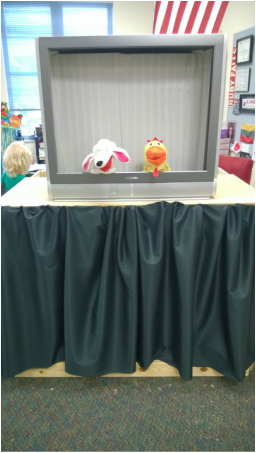
My students and I tried to pair it with an old laptop to share students' artwork as slides, but we couldn't get the signal to work. (That attempt actually scored me a not-being-used 26" TV from district for that purpose, but that story veers off from this one). This left me with a large, heavy chunk of TV taking up classroom space, so I took it apart for my students to see inside.

I made sure to bone up on TV parts that might shock me before we started, and then we marvelled at how cool the tube and the wires inside were. We were left with a big shell that made me think of kids using boxes to put on fake TV shows.

Looking in the bottom of the set, it looked perfect for sticking hands through with puppets. A few hours playing with cheap wood from Home Depot and some beginner level power tools yielded our PuppetTV theater.

Because I never say no, my students are charged up to write scripts and put on shows. We've discussed options, and in addition to writing narrative plays, they've found uses for the theater in each subject area. Today a student proposed doing presidential profiles as puppet presentations.

Our next step is setting up a YouTube Channel with videos of our shows. I'm hoping that they like the process enough that we'll have some entries for some of the many video contests I've seen online.

Don't say no. If you've got something free, challenge yourself. Challenge your students. Find new uses for old things. It ignites your creativity, and gives life to things that have lost their usefulness.

Tuesday, September 30, 2014

Snack & Share 2: The Snackquel


Our first Snack and Share went well enough, but it didn't meet one of my goals. I had been hoping to have a space for teachers to share good ideas as well as brainstorm solutions to our struggles. The stresses that you find at the start of any school year dominated the talk - and that was a good thing. When everyone is feeling stressed and tired, it's incredibly useful to get together and vent. It lets us know we're not alone.

But, but, but...

Part of me was a little sad that we didn't get much chance to share our coolness. Never mind that according to Maaslow's Hierarchy of Needs, we weren't ready to share a lot of coolness, life didn't work according to my plan. Lesson learned - let things work the way they will, when you need to, just release pressure.

This week worked out more like I'd hoped - I work with some fantastic teachers, and they brought some cool stuff. We shared some great online resources, from GoMath, Scholastic Storyworks, Storybird, Kahoot, and Bing for Schools(scroll down). We talked about different uses for these sites, and best of all, we had crackers, chocolates, lemonade, and tea.

I can't wait for October 14 to do it again!

Monday, September 22, 2014

Snack and Share


I've got so many things I want to write about, and it seems like so very little time. It's my plan to start student blogging this week, and I'm hoping to use the time when students are working on blog drafts to work on my own blog. Last week, I sent out an invitation to my coworkers. It read:

Are you doing something amazing this year? Is there something you want to do this year (but you just don’t know how)? Is there something you’re proud of? Is there something that you could use help with? Is there something cool you’ve found that you want to share? Is there something that’s really frustrating you?

--

Come on down to Mr. Farnum’s room next Tuesday (the 16th) at 3:15 for snacks and drinks, and we’ll share ideas. RSVP if you’re interested

And it's funny - I was legitimately scared to do this. The idea is exactly what I'd love to do, and I'd gotten mad love for it on Twitter. There was no reason to feel apprehensive, but what if everyone was too busy to show? I would feel so dumb! Four or five people said they'd come, several more said they would love to if only. I told them we'd do it again (if it worked out).

When Tuesday afternoon arrived, it took awhile, but a few teachers showed up, and we had a nice conversation. I had been ambitious to say bring cool things to share. At this point in the school year, every year, it seems like there's so much for everyone to do, and only a finite amount of time. And so this was a chance for a handful of us to sigh, and breathe, and to know we're not alone when we feel overwhelmed. It's the nature of a teacher to have to much on your plate, and so often we can fall into the trap of feeling like we're the only one so far behind.

I'm doing the Snack and Share based on a EdCamp model - that is, the topics are based on who's there. There's no agenda except whatever we want once we get together. It was so gratifying to listen. When we get together on our own terms, it's so clear how much skill and talent is in the room, I have so much respect for my coworkers. And to know that some of my favorite superheroes experience the same stresses that I do made my week.

I'm scheduling the next session for September 30th. The mail goes out tomorrow. Even when it's hard (and it really, really is sometimes), I love this job so much.

Tuesday, July 29, 2014

My Excitement Levels Are at a High

When I was at FETC in Orlando last year, I used my long neglected Twitter account to try to win some contests. I had no idea how much impact this would have on my teaching. I had people follow me, solely because of what I tweeted - and I became interested. I started to follow some educational hashtags (#edchat, #edtech), and the learning began. I have never seen the volume of good ideas, sharing, and affirmation in my teaching career that I have during a Twitter ed chat. Since then, I've started to follow so many different chats, and I've gotten so, so many ideas. This blog is going to be a place for me to share how they're working out. The first thing I'm planning to do this year is to step up Genius Hour. I've got a page to share information about what Genius Hour is, so I won't say much about it here, other than it's an opportunity for students to choose the direction of their learning, and a chance for me to learn more about my students. Last year, we tried it out after FCAT, and it was fantastic. This year, we'll be doing four rounds of Genius Hour, with one project each quarter. I'm so excited to see what my new students come up create. My next project is working with an open plan classroom with less desks. Instead of having assigned seats, students will work where they're comfortable (and successful) at one of the many seating options in our room. We'll have bar stool seating, a standing desk, a loveseat, floor cushions, a bean bag, a meeting table, or an individual desk. Last year, whenever given the opportunity to work together, my students took to the floor, and they did a great job. If they're achieving, why not allow them the comfort I would like to create, to read, and to learn? Once my classroom is setup, and throughout the year, I'll write about what's working, what needs tweaking, and I'll share pictures. Lastly, I've set a goal to start a St. Augustine EdCamp this fall. I'm working on putting together a team to do planning. Soon we'll pick a date and start organizing. I'm excited to see more collaboration between my students in class, and our St. Auggie teachers at an EdCamp. There are so many great ideas out there, it's time to share.